Saturday, October 27, 2007

English Essay on Look Both Ways

Ok yay, second essay in a day (oh shit, it's 3am, not a day then...)

Umm... Hopefully this turned out better than the last one. Time limit still way out, I think I need to work on somehow getting rid of distractions while keeping the computer. Is that even possible? At least the word count is more reasonable now.

My quotes definitely need work... Had to force some into it, probably very obvious where I did too >.< class="MsoNormal">

Edit: Titles are FTW

Part 2

Look Both Ways shows that despite life’s trials, happiness is possible.’ Discuss.

Happiness is one of the main themes explored in Sarah Watt’s award winning film Look Both Ways. The concept of being happy is an abstract one in a film preoccupied with other more powerful and overshadowing themes such as death and fear. Every character in the film is exposed to some form of these ‘trials’, random chance events that have the power to destroy lives. Look Both Ways explores the possibility of characters maintaining happiness despite the events that seem to have the ability to destroy any reason to be happy, and ultimately take control of lives. Some such events that might prevent happiness in the film include cancer, fatal accidents and deaths of those close to us, as well as the wider implications and people affected by each of these events, some perhaps not first-hand. However, Look Both Ways is a film which proves that happiness is not based on the difficulty of life trials, but on the strength of the human spirit that ultimately dictates the possibility of happiness. This is shown through some of the key characters in the film: Meryl, Nick and Julia.

Meryl provides an excellent example of someone who has been traumatised by her experiences with death, especially in her family. Her father’s death left her floundering and disorientated, such that her own view of life and death became distorted and fatalistic, making trite comments such as “maybe it was meant to be”. Combined with the impact of watching a man get run over by a train in front of her, her mental health has severely been damaged, made evident by the flashes of paintings that signify her imagination, filled with morbid scenes of her own death played out in countless different scenarios. She is buffeted by these bouts of paranoia and fear and “seeing death everywhere”, unable to face the world without being plagued constantly by images of her own death. Meryl seems to be completely dominated by her fears, scarred from the loss she experienced. However, despite the dreary circumstances Meryl faces, Look Both Ways is a film about hope and victory. We are shown that happiness is not dependant so much on external forces beyond our control, but rather on the strength of the inner character. Meryl realises through a chain of events together with Nick, her coming to terms with the death of her father and the accident she witnessed depended upon her own true acceptance of her circumstances. Only upon her actual submission to the fact that “things just happen” could she finally begin to regain her happiness, signified by the final photomontage at the end of the film.

Nick is another main character in the film who is subjected to the powerful forces of random events, termed life’s trials. After he was diagnosed with cancer on Friday, in response to his legitimate question “How long do I have?” he is told that “the specialist will see you on Monday”. Nick was left with nothing but his wandering, troubled mind, left to its own devices for an entire weekend, all the while harbouring the fear of this cancer that he has been told he has contracted.. After the sentence was passed by the doctor, unhealthy “speculation” is the only thing he has left to do, waiting impending doom. Happiness is probably the last thing on Nick’s mind at this stage, as his preoccupations and fears about cancer all billow out and take control over his mind, will and emotions. Despite this, the end of the film and the cathartic rain that falls symbolises hope, and Nick finally learns what it means to depend on the “light to show us the next footstep”. Nick eventually realises that he cannot fight the cancer, “then there’ll be more I don’t know”, and so in finally letting go of this inhibiting burden, and “face his own death”, he is able to take up happiness again, once again evident from the photomontage at the end of the film, where he even recovers from his cancer.

Julia is more of a peripheral character in the film; however her story ties in strongly with the centrifugal force of the film, the local train accident during which her husband perished. The loss of a loved one is a difficult one indeed, emphasised by the director in the extreme close-up shots of Julia’s face, showing the extent of the grief and devastation she experienced. In this sense, she is not dissimilar to Meryl, but they differ in their individual expressions of the grief they feel. The deep-set sorrow felt by Julia is something constantly referred to with film techniques throughout the film to alert readers as to the significance of this as a theme. After the initial shock of the death of her husband, Julia is approached by the train driver, who offers an apology in the form of a card. Julia is also offered a choice here, she could continue to dwell in her despair or accept what’s happened as unchangeable and random, and begin the journey to regaining her happiness, a door which the apology opened. Julia in exchange offered her forgiveness, freeing not only the train driver of his burden, but also of her own. By forgiving someone for the indirect loss of her spouse, she has already sown the seeds of redemption and happiness in her soul. Her husband’s death did not change, but what underwent the change to enable happiness to bloom again was her own mindset.

Ultimately, the characters in the film Look Both Ways learn that happiness is not necessarily something influenced totally by external events, but can also be engineered in them. Despite the rigorous trials of life, characters show that it is still possible to obtain true happiness independent of outward circumstances, proving that it is more a state of mind than an actual factor that they too cannot control. It can therefore be concluded that happiness is actually very much in the minds of people, able to be unearthed if it is called for by someone, regardless of their current situation, environment or difficulty they face.

Find the Maths Formula!

Edit: I wrote the generic formula right, but the actual results wrong... So yeah. Updated Numbers!

Yay fun! Find the relationship between the following numbers!

0 3 7 13 21 28 36 43

I think I might have posted this before, not too sure. Also, if it's too hard, I'll post a few more numbers after it. I made this sequence up in a Chinese Exam I believe, and (for some reason) it's written into my Physics book. So yeah

(And use the god damn tags people). Just push Show All. I've entered every relevant tag.

Friday, October 26, 2007

[Essay] The Kite Runner

So yeah, this is the first essay I've written this year for the expressed purpose of practice alone.

It was a disaster.


It went way over time, way over the unspoken word limit, and is probably largely a jumble of nonsense. Future essays should be better, please don't get turned off reading them -.-"

I just felt like it would be a waste to delete it, so i'll just post it here.

Part 1

Baba sighed, “It may be unfair, but what happens in a few days, sometimes even a single day, can change the course of a whole lifetime, Amir.” To what extent was Baba prophetic?

Khaled Hosseni’s novel The Kite Runner is one full of twists and turns, especially in the lives of his characters. It epitomizes the transient nature of humanity, and how quickly and suddenly the “course of a whole lifetime” can be redirected or shattered, simply by the presence or occurrence of one or two key events, that could take place in but a single day. Amir’s life is repeatedly subjected to these key events, events that shape and reshape the course of Amir’s life, his mindset, and ultimately his values. During Hassan’s rape on the day he won the kite running tournament, Amir’s inaction in response to that horrific act left him and his conscience scarred for life. Amir’s consequent set up of Hassan and Ali, in another selfish act to purge himself of his wrongdoing by attempting to rid himself of Hassan, resulted in both his and Baba’s devastation at the loss of people who symbolised a part of their childhood, their life. Rahim Khan’s call, convincing Amir to return to Kabul to “redeem” himself was another turning point in Amir’s life, leading up to his eventual confrontation with Assef, the catharsis of the novel in a sense. All these events, most of them arguably unfair, took place in the space of no more than a few days, yet each holds more significance in Amir’s life than the rest of it together, based on the author’s portrayal of this character. Baba’s statement holds true throughout the novel with respect to Amir’s life, and may be considered highly prophetic.

The first of the key events in Amir’s life, and possibly the most significant, was witnessing Hassan’s rape as a bystander, while doing nothing to stop it. Throughout Amir’s childhood, Hassan has been portrayed as a loyal servant, yet at the same time, a friend to Amir. His Hazara birthright dictated that this would be his place in society, and he accepted it graciously, serving Amir, a wealthy Pashtun boy, with all his heart, despite their similarity in age. Amir treated this pseudo-“friendship” with a certain degree of contempt, likely due to the fact that at the same time, Hassan was his servant, less educated, less worthy than he was. What he yearned for instead, with greater passion than anything else throughout his childhood, was the acknowledgement and “Baba’s love”, something which he felt was not present in sufficient quantity in his life. The fact that Baba showed uncanny interest in the well-being of Hassan, his servant, did nothing to relieve Amir of this burden in himself. When the time came and the strength of the bond between Hassan and Amir was tested, it is clear that while Hassan chose his Amir’s acknowledgement in exchange for his own welfare, Amir would not do the same for Hassan, who “[was] just a Hazara. I should not be expected to defend him”. While Amir obtained his father’s love from the kite which Hassan risked his life to protect, Amir clearly cannot overcome his resulting strong conscience and sense of morality, and could only temporarily “[forget] what [he] had done”. In the space of a day, Amir’s conscience from then on was forever pitted against him, for an unfair choice he was made to make as a young boy. This is what sets up the direction of Amir’s life henceforth, triggering an unstoppable chain of events. The irony of the time it took for such a significant change to occur is perfectly exemplified in Baba’s prophecy.

As a result of Amir’s actions, he could no longer face Hassan due to the weight of his guilt and regret that he carried from that day forth. Amir’s utter remorse towards himself resulted in his mentality warping, to such a point where it was impossible for him to live together with the boy who symbolised both his childhood, and his guilt and shame. In a fit of arrogance and desperation, Amir framed Hassan with the act of stealing, one which Hazaras took very seriously among themselves in relation to themselves. Ali was forced to take Hassan and leave Baba’s service, on his pride and honour as a servant. The once proud Baba was left shattered; bitterness was rife in Hassan and Ali, who both knew of Amir’s treachery right from the beginning. Amir was left alone in a void, alone in the “depths of [his] pain”, only able to regret and grieve for his own foolishness as his conscience berated him for the rest of his life for the “blackness of grief [he] had brought on everyone”. Amir’s betrayal of Hassan, Ali, Baba, and ultimately himself once again took no more than a whim to come to fruition, corresponding to Baba’s prophetic words.

Much later, when Amir was a married, middle-aged man living in America, having escaped Afghanistan before the strife brought by the Taliban began, Amir is still haunted by his actions as a boy in Afghanistan. “Steel hands closed around [his] windpipe” upon the mention of Hassan is strong evidence that Amir has been unable to leave Hassan and his past sins behind, instead carrying them inside himself. It is only after Amir is settled in his life in America that Rahim Khan, an old friend of Baba, calls him with a proposition: “a way to be good again”. Rahim Khan implied in his call that he knew everything that Amir had been ashamed about, and Amir’s decision was a difficult one, whether he should continue covering up his past or face his shame and guilt back in the “city of hare-lipped ghosts”, which he eventually chose the latter because of the pull of his conscience, and flew back to Pakistan and Kabul to face the “ghosts of [his] past”. The simple phone call by Rahim Khan resulted in some very deep-set and complex emotions in Amir being triggered, ultimately altering his life’s path altogether simply by convincing Amir to go to Afghanistan.

In Kabul, the plot reaches a catharsis when Amir is forced to confront Assef in a fight to take Sohrab, Hassan’s son, back, foreshadowed by the confrontations he had with Assef back in his childhood. Sohrab represented redemption and hope to Amir, the key to reconciling his past sins and guilt of how he wronged Hassan. As Amir was getting beaten by Assef he felt a sort of purging as a result of it, a “sense of peace” and “healing”. Amir felt that this beating was what he deserved as punishment, and it gave him a new level of emotional freedom, as he had never experienced since “the winter of 1975”. The moment of calm and joy Amir experienced changed him forever, and from then onward he felt as if he could finally forgive himself for the wrongs he committed against the now late Hassan. He took Sohrab into his care after rescuing him, the embodiment of hope and new lease of life in Amir’s life. However, the actual process of ‘restoring’ Sohrab was one that took a lot longer than a short period of time. Even at the end of the novel it is clear that Amir and Sohrab’s relationship is by no means complete or even close. This is proof that not all significant events happen in short time frames, but can take up to whole lifetimes to “melt the snow”, “one snowflake at a time”. While it took only a few moments for Amir to regain the peace and tranquillity within himself, he will probably spend the rest of his life continuously making up for Hassan in the form of his relationship with Sohrab.

The Kite Runner is proof of the volatility of life and direction in people and characters, and the power and significance of “what happens”. Baba’s prophetic words have been repeatedly proven true in the novel, especially in his own son Amir’s life, that it only takes “a few days” for life to undergo complete transformation. However, this is not always the case for all life-changing events, and many of them may take a much longer time to come to terms with or accomplish.

An Answer to Nucleic Acids

For the first part of this answer, please see the comments section of the question post.

Ok, here's a diagram of a basic DNA molecule that might help put some stuff I said in context.


EDIT: Please go look at the original image on photobucket itself (view image/drag and drop to address bar/whatever (for those of you who don't know >.>)), cbf rearranging/resizing it to fit this space.

This basically shows a double-stranded DNA molecule with some of the bonds present, also maybe make things easier to see.

P = Phosphate (circle thing), which I talked about earlier. It forms a sort of backbone along the spine of the DNA strand, as you can see.

S = Sugar (pentagon thing), which I also talked about earlier. In this case the sugar would be deoxy-ribose, since this is DNA. Bonded to P by a phosphodiester bond.

A, T, C, G = Nitrogenous Bases = Rectangle things. Yeah, these were what I was talking about, as you can see they are hydrogen bonded to their complements on the other strand of DNA.

Ok, few things I missed. T and C (U also) nitrogenous bases are actually called pyrimidines, a group that basically means single ringed structure. A and G are purines, meaning they have a double-ringed structure (much like caffeine~). For some reason, the hydrogen bonds between G and C bases are stronger than A and T, don't ask me why now, cbf. Probably just remember that.

Also, DNA strands are always bonded in opposite directions to each other. So one strand is upside down compared to the other when they are connected, symbolised by the 5' (5-prime) and 3' (3-prime) ends opposed to the 3' and 5' ends of the DNA strands. Just a side note, DNA and RNA can only be synthesised in the 5' to 3' direction. If you need more details on DNA/RNA replication please comment. Actually, comment anyway.

If you need more details on the actual structures of phosphate, sugars and bases, I will (not) draw them for you... Actually I can't really remember them. Lol, oh well. I bet your chem textbook/data sheet/google has it.

Yeah, anything you still need just put in the comment~

PS I think this is sort of helping my bio lol. Hooo~

EDIT #2: The poor kittens :'(

Thursday, October 25, 2007

A Question on Nucleic Acids

So, after 10 papercuts, blunt scissors and running out of glue, I present to you this question.

Can anyone here go through a basic (yet detailed) summary of Nucleic Acids, mostly in relation to Human Biochemistry.


[Essay] I'm Not Scared (Emily)

Well, this isn't mine, but SOMEONE (ahem Emily) is too lazy to post on this blog (probably too lazy to read/use as well)

So I'll post it for her.

I assume its for I'm Not Scared.

“Papa is the bogeyman.” Is Pino Amitrano an evil man?

In the novel I’m Not Scared, Pino Amitrano is portrayed as the villain who committed a heinous crime and betrayed his son. Pino was a man of principles and integrity who loved his family whole heartedly, yet somehow he was overcome by greed and fear which prompted him to do malicious acts which made him evil man. Through various events that took place in the novel, Niccolo Amanniti showed how he descended into darkness enabling him to commit an evil sin of kidnapping Filippo and later attempting to kill him.

At the beginning, Pino was described by Niccolo Amanniti as a short but strong man who cared deeply for his family but this was later proven otherwise as the novel progressed. He was shown to have high family values as he treasures the times he has with his family. His loving side was shown through acts of giving and humour as he bought gifts for his children and joked with his family. He bought Marie a new pair of glasses and a “gondola” for Michele. He took back his role as the head of the house whole when he told Teresa not to worry about fetching the water and that he would go instead of the kids. “…I need to get something from the van anyways…” He all showed his fathering side when he played “soldier’s draw” to settle a little argument between Marie and Michele. Through these little gestures of affection, it does not seem like his is an evil man, however this was proven otherwise when he ignored Michele’s explanation as to why he was late. He had totally shut Michele off and told him to “get out”. His anger was the first sign of his capability for evil. He used vulgar words towards Michele “…what have you been rolling in...you smell like shit…” which further enforced his capability to inflict evil upon others in particular Filippo and Michele.

As the novel progressed further, Pino’s capacity to inflict evil up on other become clearer when Michele found Filippo and made the connection of this discovery with his father. The condition that Filippo was in is further proof that Pino is an evil man. Filippo’s skin was “…caked with mud…eyelids were sealed with blood…lips were dark and split…All his teeth had gone black.” Pino and the adults of Acqua Traverse treated Filippo like an animal and an item of trade. They did not give Filippo enough food, starving the boy in a dirty whole. They fed him scraps from home, for example the meat that Marie did not want to eat. They gave him just enough food to sustain his life long enough to complete their transaction. Pino further showed his capacity for evil when he confronted his son and blackmailed him into not visiting Filippo again. “…swear that you will not go back there…swear on your fathers head…if you go back….these people will kill him and it will be your fault” It was harsh of Pino to endowed such a heavy weight upon a nine year old child’s shoulder. Apart from this, Pino also tried to buy Michele’s silence buy purchasing a new red bike for him. Pino’s naïve thinking destroyed Michele’s innocence. He has mentally and physically harmed both his son and Filippo. He had betrayed Michele when he did not stand up again Sergio “…felt like I had been stabbed on the side…papa was the boss of Aqua Traverse” and then showed Michele his capability to harm when he said “Two ears we’ll cut off. Two.” His ability to be so cold and uncompassionate destroyed the respect Michele had for him as well as his innocence. At the end of the novel, Pino’s full capacity to inflict evil was shown when he set off to kill Filippo. He had lost the game of “soldier’s draw” and had become the executioner. However, there was a twist to the ending where he did not shoot Filippo but his own son. The fact that he shot the bullet shows that Pino is in fact an evil man.

Niccolo Amanniti captured every aspect of Pino’s character, vividly demonstrating his capability to inflict evil through various events. Pino chronically descended into darkness, which clouded his judgement thus destroying his principles as can be seen throughout the novel. His moral values were eroded by his greed, fear and desperation. It was his self destruction which made him and evil man.

Wednesday, October 24, 2007

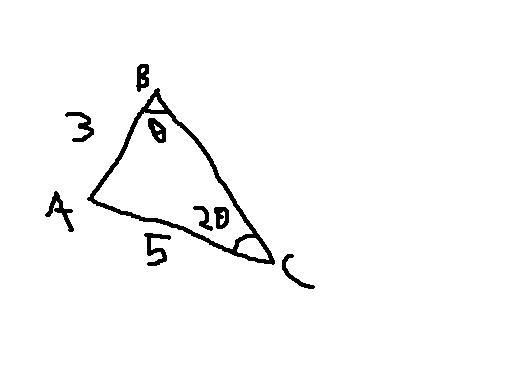
Actual Solution to 'Simple' Trig Problem

Using a totally non-stolen picture*

*Using Microsoft terms**
**Disagreement with these terms will result in your computer having 'mysterious' BSOD whenever you try to complain, or in extraneous circumstances***
*** Eg. When we feel like it.

Super Edit:!!! I just realised as I did this problem, that the picture indeed IS wrong. The 3 and 5 (cm) are in the wrong positions. If you swap them Around, it's okay. So the picture IS wrong. Swap the 3 and 5 around ok.

So now, I've got to draw it in Paint.


So. I suppose I'll do it in Mathtype.

It's a bit small, but that explains everything I suppose.

What a fun problem huh?